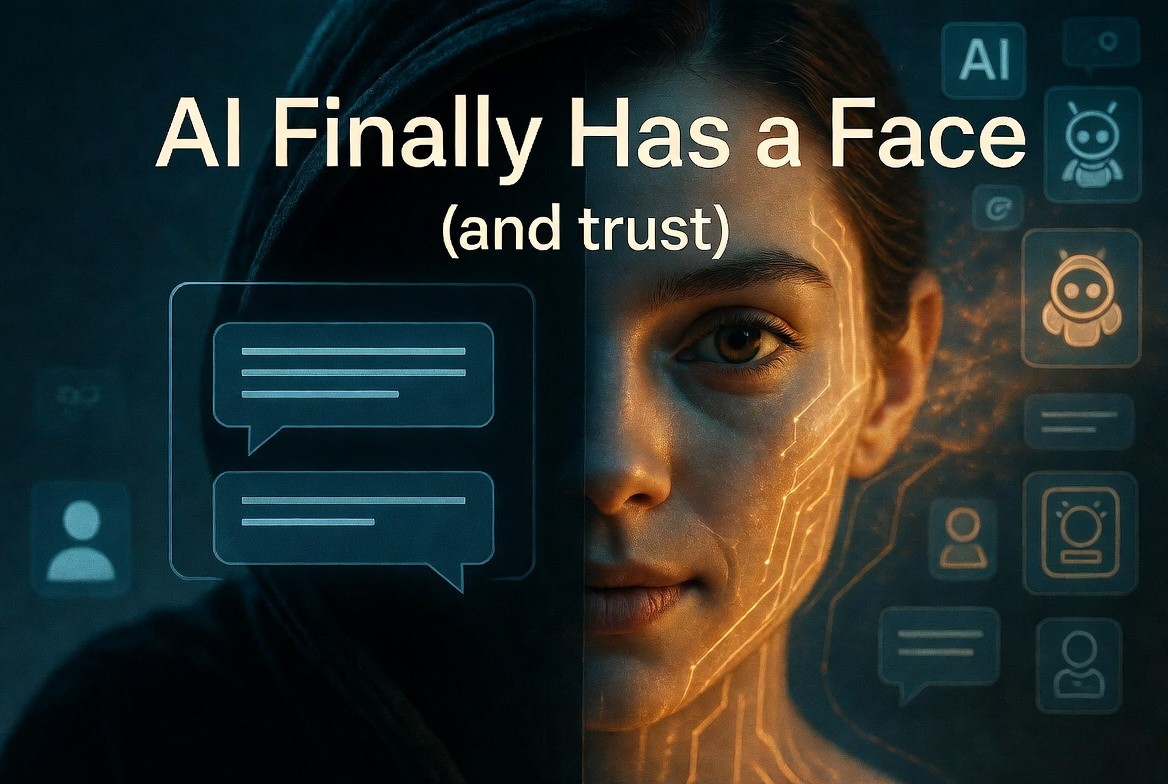
AI FINALLY HAS A FACE (AND TRUST)
Something is happening across the AI industry right now that nobody planned for but everyone is starting to feel. The labs are building pixel avatar creators. Developers are giving their agents characters that live inside your desktop. The most forward-thinking builders are all arriving at the same realization at the same moment: the next frontier of AI is not intelligence. It is identity.
And Genies has been building that infrastructure for years.
This is not a trend. It is not a feature request. It is a structural gap in how AI exists in the world, and it is becoming impossible to ignore. Agents are running autonomously across every industry. Models are embedded in products that touch billions of people. Millions of conversations are happening every single day between humans and AI, not as experiments, not as demos, but as genuine parts of how people work, create, learn, and connect. The capability is extraordinary. The adoption is real. The technology has crossed every threshold anyone set for it.
But something fundamental is still missing from almost all of it.
Identity.
AI without identity is AI without trust. And without trust, you are leaving the most important part of the whole equation on the table. Not the technology. The relationship. The compounding, loyalty-driving, revenue-generating relationship that separates products people return to from products people abandon the moment something slightly better appears.
Right now the most powerful AI systems ever built still show up as text in a box. A response from nowhere. A voice with no origin. They execute at superhuman levels, reason through problems that used to require entire teams, and generate output that would have seemed impossible a few years ago. But they do not exist as anything. No face you have seen before. No personality that carries from one session to the next. No presence that makes you feel like someone is actually there.
That gap, specifically that gap, is where trust breaks down every single time.
A face changes this at a level that goes deeper than design or aesthetics. It triggers something fundamental about how humans build confidence in anything. When something is recognizable, when it has a consistent presence and a personality you have encountered before, the brain stops evaluating it as a tool and starts relating to it as something real. Familiarity creates confidence. Confidence drives engagement. Engagement compounds into loyalty. And loyalty is where all the actual value in any product lives. More time spent. More willingness to pay. More organic growth. More resilience against the next competitor who ships a slightly better model next quarter.
This is not a soft insight. It is the mechanism behind every product that has ever built a genuine relationship with its users. And it is the exact mechanism that AI has been missing.
What Genies Built
Genies built the visual and embodiment layer that AI has needed since the beginning. The complete infrastructure to create a character with a face, a voice, a distinct personality, behavioral logic, and emotional range, and plug it into any platform, app, game, or product with minimal friction.
Think of it like how apps plug into LLM APIs today. A partner integrates Genies, pays based on usage of the character's look and behavior models, and then builds whatever monetization model makes sense for their product on top. Subscriptions. In-app purchases. Premium character unlocks. Fan experiences. The character infrastructure is Genies. Everything built on top of it belongs to the partner. Enterprise products get bespoke packages built around their specific scale and use case.
The creation side handles the full range of people who need this. A technical team can fine tune behavioral logic, train custom models around a character's personality, and integrate with precision. A creator or product team with no technical background can design and deploy a character without writing a single line of code. The depth is there for builders who want it. The simplicity is there for everyone else. Both end up with something genuinely theirs that lives wherever their product lives.
The Landscape It Covers
The use cases are not niche. They span everything.
In entertainment, the opportunity is transformational for the world's most valuable IP. Characters that fans can actually talk to. Athletes who exist as interactive presences engaging their audience between seasons and between games. Musicians and celebrities who can show up in experiences their team could never staff manually. Streaming platform avatars. AI hosts and presenters. Interactive content where the characters actually respond to you. IP that has spent decades building emotional equity now has a way to activate that equity at scale, interactively, in real time, across every platform audiences already live on.
In gaming, the shift is just as significant. AI characters that do not follow scripts but respond dynamically to what a player actually does. Enemy characters with genuine behavioral logic. Playable AI teammates that feel like real presences inside the world. Virtual streamers. An entire game cast that players form real relationships with rather than simply interact around. That is a different product entirely, and it creates a different kind of retention that no amount of additional content alone can replicate.
In the creator economy, the math has always been brutal. Finite hours. An audience with unlimited appetite for access. A character built in a creator's image, trained on their voice, their humor, their aesthetic, their specific way of seeing the world, can exist in the places they physically cannot. Talking to fans around the clock. Living inside games the audience plays. Running community spaces with real personality. The relationship scales without a ceiling. The creator does not have to.
In consumer products, the surface area is enormous. AI companions with actual personality. Personal assistants that feel like someone who knows you. Fitness coaches, wellness guides, tutors, and shopping assistants that feel personal rather than transactional. Brand mascots that exist as interactive presences rather than static logos. Every consumer touchpoint that currently feels like a feature becomes something that feels like a relationship.
In enterprise, the problem is one every operator recognizes. Software that functions but does not resonate. HR platforms employees dread opening. Training tools that feel like mandatory compliance exercises. Knowledge agents that feel like slightly smarter search bars. Give any of them a face, a consistent character that feels like a colleague rather than a system, and the entire dynamic between employee and software shifts. Adoption increases. Engagement improves. The product stops being something people work around and starts being something they actually use.
The Trust Equation Nobody Is Solving For
Intelligence is no longer the differentiator. It is increasingly the baseline. Speed, accuracy, reasoning capability, all of it is advancing so fast across the entire industry that the gap between competitive models narrows every single quarter. What does not commoditize at the same rate is relationship. Character. The specific trust a user builds with a presence they recognize and have experienced consistently over time.
Most AI products right now are asking users to form a relationship with something that has no persistent identity. No face they remember. No personality that feels coherent across interactions. They are asking for trust without giving people anything solid to anchor it to. Users feel that gap even when they cannot articulate it. It is why engagement drops. It is why churn happens even when the underlying model is genuinely excellent. It is why the best technology does not always win.
Genies solves that. A character that shows up the same way every time. A voice that is recognizable. A face that carries across every platform and surface. A personality consistent enough that each interaction feels like a continuation rather than a fresh start. That converts an impressive AI experience into a trusted one. And the business outcomes of that conversion are not subtle. More sessions. Higher time spent. Better retention. More referrals. More defensibility against whatever drops next quarter.
Why Now
Every major platform, every serious enterprise product, every creator with a real audience, and every AI agent built to interact with humans at scale is going to have an AI persona. That direction is already set. The open question is not whether AI gets an identity. It is who builds that identity, what it is built on, and whether it happens now while it still creates real differentiation or later when it is simply the cost of staying in the game.
The ones who build identity now own the relationship later. Not just the user. The trust that makes the user irreplaceable, the engagement that makes the platform defensible, and the character that makes the product something people actually talk about.